
San Mateo County's Directory Shelf
San Mateo County city directory research starts with the San Mateo Main Library California Collection. Its documented run begins in 1907 and reaches the present, with Polk, Haines, and other publishers represented. The collection supports three approaches: a personal-name search, a business search, and a street-address search. The years do not form one perfect digital series. Some volumes are bound, some are on microfilm, and some titles must be located through a catalog before a visit. Treat the publisher and title page as evidence of coverage, because a volume labeled for San Mateo can include more than one Peninsula community.
| Collection | Years / publisher | Where held | Access and use |
|---|---|---|---|
| San Mateo city directories | 1907-present; Polk, Haines, and others | San Mateo Main Library California Collection | Onsite; search by person, business, or street |
| Spaulding-Bonestell precursor | 1905-1906; San Mateo City and County Directory | California State Library catalog and local libraries | Locate the title, then request the volume onsite |
| Reverse and criss-cross runs | Later Polk and Haines volumes; first year not published | San Mateo Main Library | Ask reference staff to identify the street section |
| San Mateo Times and local papers | San Mateo Times from 1901; Gazette and News Leader runs | San Mateo Main Library microfilm | Onsite obituary, address, and event research |
| Sanborn fire maps | 1920s-1930s San Mateo sheets | Main Library and selected Library of Congress sheets | Building and numbering context, not occupant names |
| Schellens abstracts | 1852-1975 California materials | Redwood City Main Library and SMCGS copies | Index bridge to books, directories, and newspapers |
For shelf questions, call the Main Library Reference desk at 650-522-7818 or write to smplref@plsinfo.org before traveling. Staff can identify missing years, the exact Polk and Haines runs, the first reverse section, reproduction rules, and whether another Peninsula library holds a city title. San Mateo County Libraries adds genealogy databases, including Ancestry Library Edition inside branches or on branch Wi-Fi, plus remote HeritageQuest and HeritageHub access for qualifying card prefixes. The physical shelf and the licensed databases solve different gaps.
The San Mateo Public Library California Collection page is the best starting point for its directory, newspaper, map, and clipping holdings.
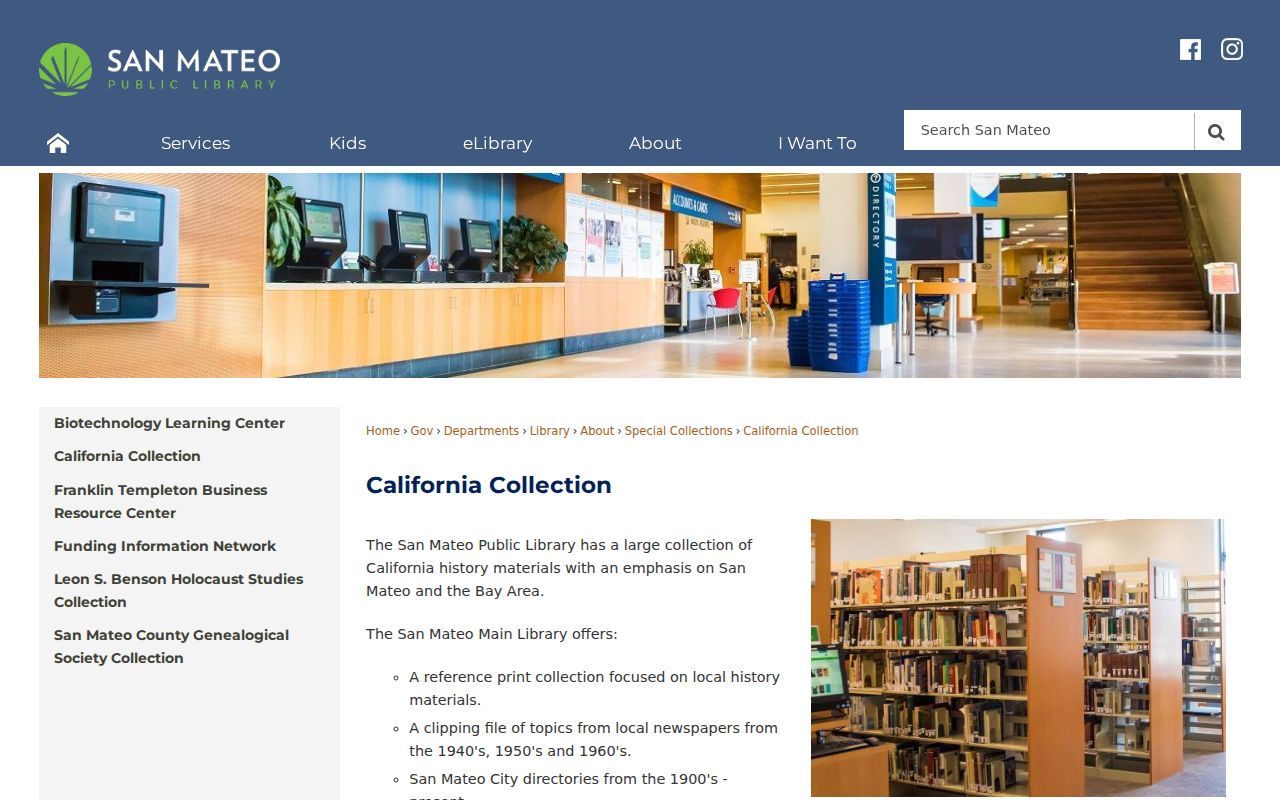
The library image represents a local-history shelf that still requires title-by-title checking. A catalog description is a lead, while the volume's own year and publisher establish what a search can support.
The 1905-1906 San Mateo City Directory
The 1905-1906 San Mateo City and County Directory, attributed to Spaulding-Bonestell, is the key precursor to the Main Library's practical 1907-present run. It matters when a family or business appears just before the better-known Polk and Haines series. The title also warns against treating a modern city label as a fixed boundary. Earlier county and locality volumes may gather entries from several Peninsula communities, while a town title may sit inside a regional volume.
Use the California State Library's specialized city-directory catalog to locate the precursor and related locality runs. Search San Mateo, Redwood City, Daly City, South San Francisco, Burlingame, San Bruno, Menlo Park, and Half Moon Bay separately. If the catalog points to a physical copy, ask the holding library about onsite access, microfilm, reproduction, and any missing pages. A name search is only as strong as the volume's stated coverage.
Publisher changes also change the clues. A nominal publication year may reflect a late prior-year canvass, and a new title may alter abbreviations or the order of names. Copy the title page, publisher, place, coverage statement, and abbreviation page before comparing entries across years.
Reading a San Mateo County Directory Entry
A Polk or Haines alphabetical entry commonly begins with a surname and given name or initial. A spouse may appear in parentheses, and a widow notation can identify a change in household status. Occupation text, when present, helps distinguish two people with the same name. Residence addresses are the bridge to a reverse section, a census place, a newspaper notice, or a later property record. Business entries may show a trade and business address instead of a home.
| Name | Surname, given name or initial, and sometimes a spouse in parentheses |
|---|---|
| Household clue | Widow notation or another relationship mark that appears in that year's style |
| Occupation | Occupation text, when the publisher included it |
| Residence | House number and street, with abbreviations such as h, r, or b |
| Business entry | Trade and business address, which may differ from a residence |
| Owner or renter mark | Copy the symbol and its key; not every run uses the same notation |
- Criss-cross directory
- A reverse section arranged by street and house number, with a listed occupant or business when the volume includes one.
- Householder index
- A name-focused index to people treated as household heads or primary occupants; it does not prove that every resident was listed.
- Abbreviation key
- The publisher's decoding page for short forms such as h, r, emp, wid, street names, and compass directions. Photograph it first.
Typography varies by year. Read the symbol in context, cite the volume title and publisher, and keep a note of the page number. A listed resident is evidence of directory presence, not automatic proof of ownership or a complete household.
San Mateo Reverse City Directory Search
Later San Mateo County city directories can answer a different question when the name is unknown. The alphabetical section starts with a person. The reverse or criss-cross section starts with a street number, then supplies the listed occupant, business, and sometimes telephone information. The exact first year of the reverse run is not published, so ask Main Library reference staff to identify the earliest bound volume and any missing years.
Compare the same address in both halves of a volume. The alphabetical entry may reveal a spouse or business connection, while the street-order entry can expose a multiunit listing or a different spelling. Check the abbreviation key before reading a short mark as a relationship. If a street was renumbered, use Sanborn sheets and newspaper notices to keep the old and new numbers aligned.
For a modern address-keyed chain, the San Mateo County Street Directory page handles parcel and current street research. The historical volume remains the better source for a listed occupant when title records name only an owner.
Digitized San Mateo County Directories
Digitization is useful, but it is not a complete substitute for the local shelf. The Internet Archive subject search can surface scanned San Mateo County directories, telephone books, or nearby locality titles. Confirm each item's title page, publisher, inclusive years, scan quality, and place coverage. A search-result label is not enough, especially when a county title and a city title use similar names.
The digitized San Mateo County directory search provides a free online lead for items that have been scanned.
The archive view is most valuable when paired with a local volume. If a scan skips a year, omits a reverse section, or loses a page, return to the Main Library, the California State Library catalog, or another Peninsula library rather than treating the gap as a move.
Tracing Families Through San Mateo County Directories
A human-use search works best when each entry is treated as one dated observation. Start with a known household and preserve the exact spelling, spouse, address, and any occupation or business clue. The 1930, 1940, and 1950 federal census schedules provide decade anchors through the 1950 release available in 2026. Directory years fill the moves between those snapshots, but boundaries and canvass dates can differ.
- Find the person's first appearance in a known directory year or in the 1930, 1940, or 1950 census, then copy every household detail.
- Check nearby directory years and record each address change, spouse change, spelling variation, and possible skipped volume.
- Flip to the criss-cross section for the same street and number to compare neighbors, multiunit entries, and business listings.
- Pair each directory decade with its corresponding census, allowing for enumeration boundaries and households that changed between visits.
- Close the trail with San Mateo Times microfilm, an obituary or cemetery index, and then assessor or deed evidence for ownership.
A person disappearing from one San Mateo County city directory may have moved, died, been missed by a canvass, or been omitted from that publisher's coverage. Look for a spouse under a prior or married name, check the reverse section, and inspect newspaper notices before drawing a conclusion. Directory presence can represent a resident without representing an owner.
When an old entry needs a current identity check, the San Mateo County Resident Lookup workflow adds court, vital, property, and official affiliation records without treating one matching name as proof.
San Mateo County Directory Companions
The San Mateo Times reaches back to 1901 on Main Library microfilm. Gazette and News Leader runs add local coverage, while the library's clipping file from the 1940s through the 1960s can capture an address, business change, obituary, society notice, or property event missed by a directory. Search the newspaper after a name or address appears in print, then compare the result to the directory's stated year.
Sanborn fire-insurance maps from the 1920s and 1930s add a physical check. The Library of Congress Sanborn collection has selected digitized sheets, while the Main Library holds local material. A Sanborn sheet can show a building footprint, use, materials, and street numbering context. It does not name occupants, so it supports a city directory entry rather than replacing it.
Yearbooks, church registers, cemetery records, and obituary databases can supply a family clue. San Mateo County Libraries offers Ancestry Library Edition, HeritageQuest, HeritageHub, and My China Roots through its genealogy resources. These sources can identify a likely event or relationship, but a certificate or court file still comes from its official custodian.
A directory search also needs the right local jurisdiction. San Mateo County has 20 incorporated cities and unincorporated communities, so city clerk, building, and planning files are kept by the responsible city or by County Planning. Permit files may name an applicant, contractor, site, status, and dates, but they are not complete resident rolls. Birth, death, and marriage certificates remain county or state records. For unincorporated planning material, the documented fallback is a County Planning request by email, mail, or Permit Counter.
The San Mateo Directory Quirk
Richard Schellens created an unusual bridge between printed city directories and scattered county records. The Schellens Collection covers California materials from 1852-1975 and includes hand abstracts from directories, great registers, county books, and newspapers. Three Redwood City real-estate volumes add hand-drawn maps and Official Record references. That work can turn an old name or citation into a more precise request for a book, page, or file.
The San Mateo County Genealogical Society databases include early deeds, mortgages, patents, lis pendens, judgments, jury lists, court material, mortuary records, Sheriff sales, and tax sales. The index is a lead, not the original record. Keep its citation, then ask the custodian or archive for the underlying volume when the research calls for it.
The database screen shows how a county-specific index can reach beyond a standard city directory. The SMCGS library information identifies the Schellens abstracts and local collection access.
San Mateo Old Courthouse Directory
The restored 1910 Old County Courthouse now houses the San Mateo County History Museum and an archive research room. The Historical Association, founded in 1935, holds photographs, manuscripts, maps, newspapers, public records, and organizational material that can explain why a directory entry changed. These holdings are especially useful when a name appears in a directory but the family story depends on a local event.
The online catalog is a finding aid, not a complete inventory. Most Historical Association holdings remain in an onsite card catalog, and many materials are available only through an appointment. Search the catalog first, record an item title or identifier, then request the material ahead of the visit.
The Historical Association PastPerfect catalog provides the online starting point for county photographs, documents, and objects.
Archive access is by appointment through archives@historysmc.org or 650-299-0104. Bring photo ID and ask staff to pull catalog items in advance. That access step matters when a directory clue leads to a unique photograph, map, or organizational file.
A San Mateo County Directory Timeline
Record-keeping in San Mateo County is layered. County formation, printed directories, local maps, archival catalogs, and current parcel systems answer different questions. A short timeline keeps a search from forcing one source to cover every era.
- 1856: San Mateo County separates from San Francisco County territory, so earlier land and court material may sit with San Francisco or federal sources.
- 1905-1906: the Spaulding-Bonestell San Mateo City and County Directory provides a documented precursor.
- 1907-present: the San Mateo Main Library reports a practical city-directory run with Polk, Haines, and other publishers.
- 1910 and later: the restored Old Courthouse becomes a local museum and archive setting for records beyond the printed shelf.
- 1920s-1930s: Sanborn maps supply building and street-number context for directory and census work.
- 2026: current parcel datasets export daily, while the upgraded Property Information Portal and onsite catalogs continue to serve different eras.
That last comparison is central. Current parcel exports are refreshed daily and are useful for an APN, jurisdiction, or present parcel clue. The Historical Association's catalog is mostly onsite and is useful for older photographs, manuscripts, maps, and organizational records. Neither replaces the other, and a city directory search is strongest when the dated print entry is connected to the right historical or current record.