
Sources for San Mateo County Previous Residents
One address has more than one history. The ACRE property and recorder records are strongest for parcel identity and title. Printed directories and census schedules are stronger for household presence. Sanborn maps show whether a structure and its use fit the address, while newspapers, permits, obituaries, and probate can explain a change between two snapshots. The table sets the expected era before a search begins.
| Source | Years It Covers | Where Held | What It Shows |
|---|---|---|---|
| ACRE Recorder online index | Online cutoff not stated | ACRE web index | Recorded parties, instruments, dates, and a path to the deed image or copy. |
| Historic Recorder books | 1856 forward, series varies | Recorder counter and archive | Earlier title entries, legal descriptions, and citations beyond the web index. |
| San Mateo city directories | 1907-present | San Mateo Main Library California Collection | Listed residents or businesses by name, street, and sometimes reverse address. |
| Sanborn fire maps | 1920s-1930s | Main Library and selected digitized sheets | Building footprint, use, materials, and address continuity, not occupant names. |
| Federal census | 1850-1950 | NARA and library databases | Household relationships and an enumerated place at each released decade. |
| San Mateo Times microfilm | 1901 onward | San Mateo Main Library | Obituaries, transfers, society notices, and address or family clues. |
| Schellens abstracts | 1852-1975 | Redwood City library and SMCGS copies | A bridge across directories, great registers, county books, and newspapers. |
| Permit and planning files | Varies by city and parcel | City departments or County Planning | Physical changes, project dates, applicants, and contractors where public. |
Start with the source that matches the question. A recent owner trail begins at the parcel. A 1920s household may begin with a directory or census. A nineteenth-century title problem may require the Recorder counter, Schellens, early land indexes, or a historical archive. The previous residents of one address are usually assembled from overlap, not found in one complete roll.
Start a San Mateo County Resident Search
Normalize the street number, direction, suffix, postal city, and ZIP, then search the ACRE Assessor online services or County Property Information Portal. Copy the APN, situs address, jurisdiction, map reference, and legal description. Those fields matter when a street name changed, a number was reassigned, or an older deed uses a lot, block, tract, subdivision map, rancho, or metes-and-bounds description.
The APN is the durable bridge from the current parcel to an acquisition instrument. A situs address identifies the physical tax site. A mailing address is where tax correspondence goes when released and may be off site. Neither field alone identifies every person who lived at the property. The current assessor record can suggest where to start, but the recorded deed and household sources must carry the historical claim.
For the current parcel chain, the San Mateo County street directory explains the address-to-APN handoff and the present-day map method. The backward search then narrows to one parcel instead of mixing nearby addresses.
Follow San Mateo County Previous Residents
The recorded title trail is a sequence of parties and instruments. ACRE’s grantor-grantee index is name-driven, so the address must first produce a current owner or acquisition reference. Open the instrument when possible and preserve the recording date, document number, legal description, and party roles. Then use the seller as the next historical search name.
- Capture the current APN, situs address, and legal description from assessor or parcel material.
- Find the current acquisition deed in the ACRE Recorder index and note grantee, grantor, recording date, instrument number, and book or page when shown.
- Search the grantor as a grantee in an earlier date range, then compare the APN or legal description to confirm the same land.
- Repeat the seller-to-earlier-buyer search until the online results stop or the title trail reaches a useful historical point.
- Move to Recorder books, Official Records, counter help, or archival indexes for years outside the web coverage.
- Grantor / grantee
- The grantor transfers or releases an interest. The grantee receives that interest. One deed can contain several parties and roles.
- Chain of title
- The linked sequence of recorded transfers that connects a present title interest to earlier parties and instruments.
- Legal description
- The formal land wording that identifies the parcel by lot, block, tract, map, rancho, or metes and bounds. It can remain useful when street text shifts.
A deed chain identifies ownership events, not the full list of previous residents. A household source must supply the occupancy layer.
Find San Mateo County Previous-Resident Records
The ACRE public landing page does not publish the earliest online grantor-grantee year, result cap, or complete document-type list. Do not turn an empty web result into a claim that no earlier owner existed. Contact the Recorder at 555 County Center, first floor, Redwood City, at recorder@smcacre.gov or 650-363-4500. Ask which book, index, Official Record series, or instrument citation covers the period in question.
When a counter visit is not practical, use the Recorder's written or mailed request route for a known instrument, book and page, or index citation. Confirm the current form, copy or certification fee, and any retrieval rule before sending a request.
ACRE’s public hours are Monday through Friday, 8 a.m. to 5 p.m. Walk-ins depend on capacity, and appointments are encouraged. A counter search can identify a citation or provide a copy route. Earlier books may need staff retrieval. The index itself can show grantor, grantee, recording date, document or instrument number, document type, and sometimes book/page and legal-description cues. An image or certified copy is the better evidence for vesting language and parcel identity.
If an older title trail remains hard to follow, compare the citation with SMCGS early land, mortgage, lis pendens, judgment, Sheriff-sale, and tax-sale indexes. Schellens abstracts and Historical Association material can supply another path to the same book or page.
Schellens and San Mateo County Past Residents
The Schellens Collection is an unusual bridge for previous residents. Richard Schellens extracted people from directories, great registers, county histories, books, and newspapers. The collection covers California material from 1852 to 1975, and three Redwood City real-estate volumes include hand-drawn maps and Official Record references. Those abstracts can point from a name or address clue to a deed citation, directory entry, or newspaper item that is not easy to locate through a modern portal.
Copies are held through Redwood City Public Library and the San Mateo County Genealogical Society. The SMCGS library information page is the source route for collection access and the house-history lead. The Historical Association also holds photographs, maps, manuscripts, newspapers, and public-record material. Its online catalog is incomplete, so a catalog number and advance request to the archive can be more useful than a broad keyword search.
The Schellens bridge is especially valuable when a previous resident appears in an old directory but not in the modern deed index. Treat each abstract as a finding aid. Check the cited original, record the exact volume and page, and keep the address, spouse, occupation, or map clue that distinguishes a same-name person.
The SMCGS library information page illustrates why the historical portion of a San Mateo County previous-residents search may require a shelf or archive request.
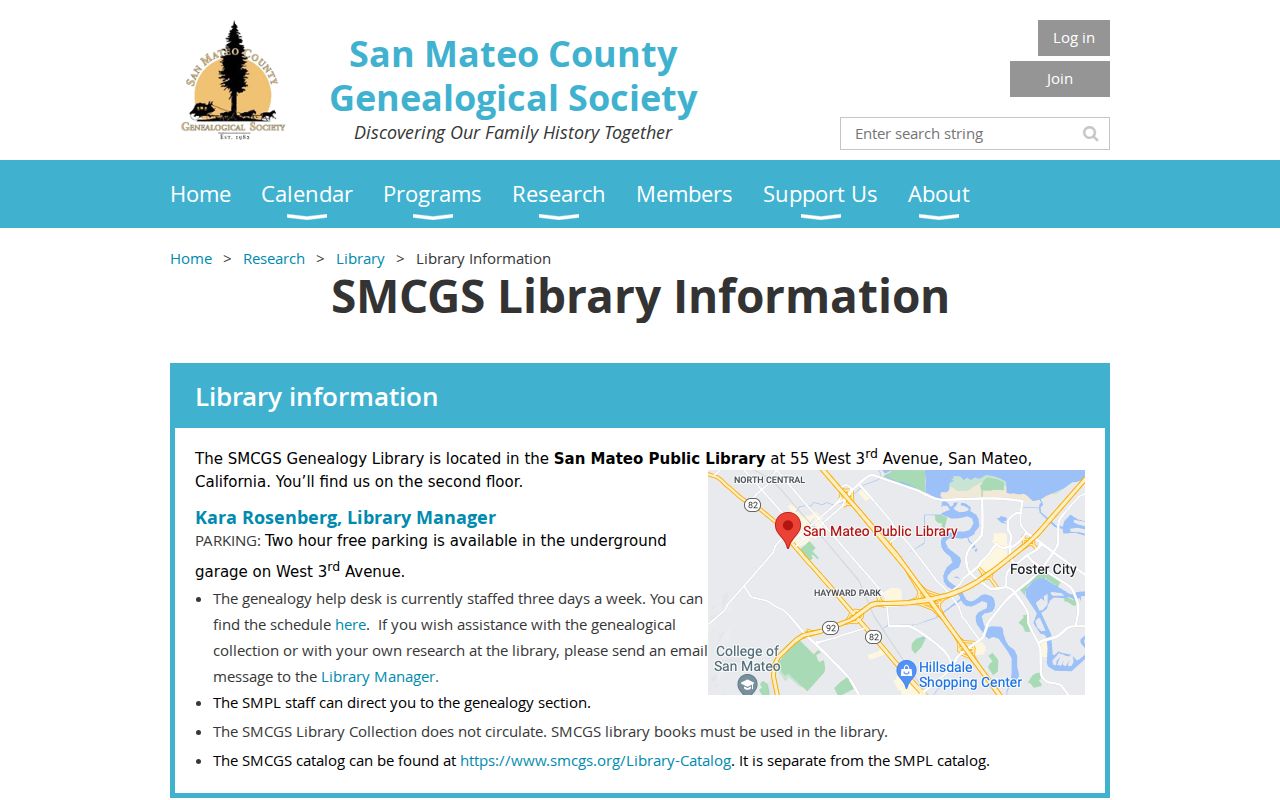
The collection adds a local bridge between names, parcels, maps, and older county records without treating an abstract as a certified copy.
San Mateo County Directories Track Past Occupants
San Mateo Public Library reports city directories from 1907 to the present, with Polk, Haines, and other publishers. The California Collection supports searches by personal name, business, and street address. A later reverse section may arrange entries by street, then house number, with a listed occupant or business and sometimes a telephone. The exact first reverse-directory year is not published, so ask reference staff instead of assuming that every annual volume has the same format.
Call Reference at 650-522-7818 or email smplref@plsinfo.org before a visit. Ask about the earliest bound volume, missing years, publisher runs, open-shelf access, reproduction rules, and branches holding other Peninsula cities. Photograph or transcribe the title page and abbreviation key before interpreting marks such as h for house or resides, r for rooms or resides, emp, wid, compass directions, and street abbreviations.
An alphabetical entry may show a surname, given name or initial, spouse, widow notation, occupation, and residence address. A reverse listing can show who was listed at the number, but it does not establish ownership. The San Mateo County Directory Book covers the directory collections themselves; the previous residents search uses one entry to connect a known address to a past household.
Match San Mateo County Directories to Census
Federal census schedules through 1950 are available under the 72-year release rule. NARA and FamilySearch provide name and place approaches, while San Mateo County Libraries genealogy resources provide Ancestry and HeritageQuest access routes. The census is a decennial snapshot, not a continuous address roll. Boundaries, street numbering, spelling, and the wording of an enumerator’s place description can shift, so pair it with a nearby directory year and the parcel evidence.
- Choose a directory entry with an exact number, street, household name, spouse, occupation, or nearby business clue.
- Search the nearest released census year by name and place, then inspect the full household rather than copying one line.
- Compare the street, dwelling number, family members, ages, occupation, and enumeration district with the directory entry.
- Check the adjacent directory years for a move, skipped volume, spelling change, or multiunit listing.
- Use a Sanborn sheet, deed, permit, obituary, or newspaper notice to explain a mismatch before concluding that the household left.
A 1950 census household paired with a 1951 directory can show a family transition, but it cannot prove that every person named in the census held title. The strongest house histories keep the ownership and occupancy columns separate.
San Mateo County Previous Residents Sanborn Maps
San Mateo sheets from the 1920s and 1930s help stabilize an old address. The maps show building footprint, use, materials, and nearby structures. They can reveal whether the numbered structure existed, whether a lot held more than one building, or whether a street layout explains a directory mismatch. They do not name occupants and should not be used as a substitute for a resident record.
The San Mateo Main Library California Collection holds local Sanborn maps, and the Library of Congress Sanborn collection has selected digitized sheets. Compare the map with the title-page year, the directory address, the parcel geometry, and any legal description. A map can support physical continuity even when the number or postal label changed. It cannot by itself date an owner transfer or identify who lived inside.
For a street number that no longer matches, keep the old spelling and number in the research log, then test the modern APN and subdivision map. That pairing is safer than silently replacing an old address with a modern one.
San Mateo County Past-Resident Trail
Permit and planning files explain the building, not every household. City coverage varies. For an unincorporated parcel, County Planning accepts a California Public Records Act request by email, mail, or at the Permit Counter. Existing permit cards may show address, scope, dates, applicant, or contractor. Official plan copies need owner and design-professional authorization plus an affidavit, and a paid research or review request may be needed when staff must analyze planning, zoning, or building material.
Newspaper evidence can fill the years between directory volumes. San Mateo Main Library holds San Mateo Times microfilm from 1901, as well as Gazette and News Leader runs. Search obituaries, property notices, society items, family announcements, and address changes. A clipping file from the 1940s-1960s can catch a business or family move that an index misses. Use the library reference desk for exact dates and microfilm access.
Probate can explain why title passed through an estate. The San Mateo Superior Court MIDX index is a starting point for a case or party, while Odyssey and the proper clerk hold fuller case information. Match any probate clue to a recorded deed, obituary, or cemetery record. A newspaper notice is a lead; the custodian’s record is the stronger source.
Close a San Mateo County Previous-Resident Search
The final account should show which fact came from which source. A current deed can establish a title event. A reverse directory can show a listed occupant. A census can show a household at an enumerated place. A Sanborn map can support the building context. An obituary or probate file can explain a departure or transfer. Keep those statements distinct when writing about previous residents of the same address.
For a family-history use case, a 1950 census household, a nearby directory entry, a Times obituary, and a deed citation can reconstruct a move across San Mateo County without claiming that every household member owned the parcel. For a house-history use case, APN, legal description, maps, permits, and the deed chain can show how the site changed. When the trail ends, record the gap, the custodian contacted, the volume or case searched, and the next requestable citation.
Lawful house history. Previous-resident research is appropriate for family history, genealogy, a property’s past, or personal curiosity. Do not use records to track, intimidate, harass, or harm a living person, and do not publish sensitive details that are not needed for the lawful purpose.